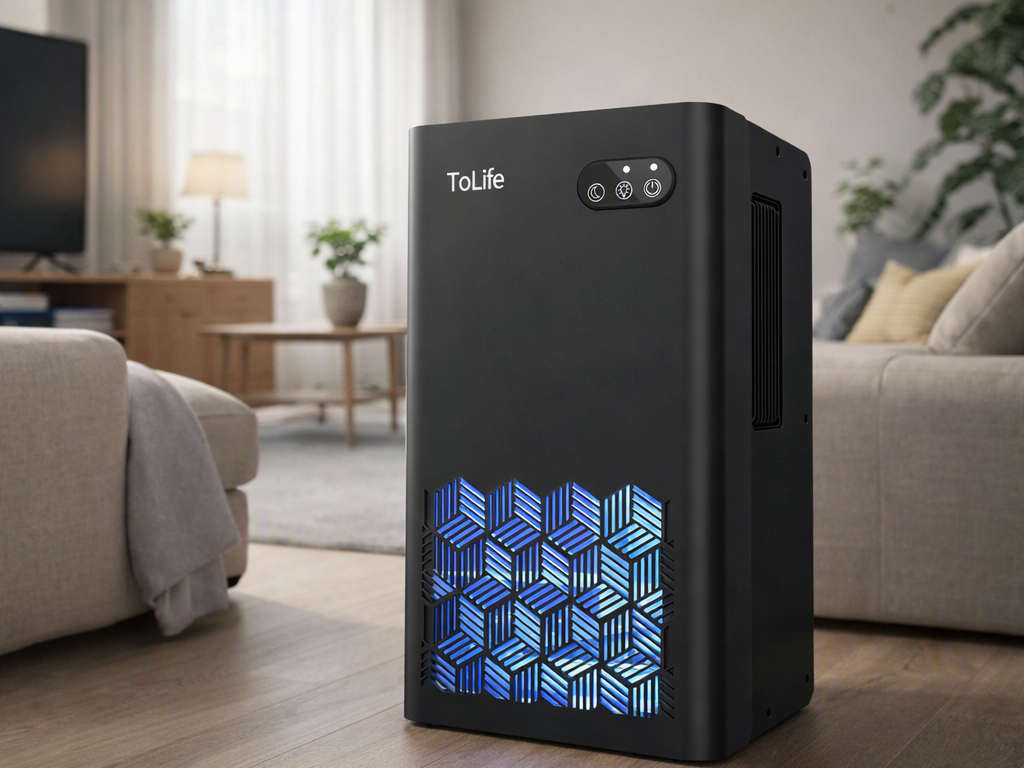
By a home-climate-control reviewer who has spent way too many years testing moisture-control appliances for small and mid-sized living spaces.
I’ve tested a lot of dehumidifiers. Big compressor units that practically rattle the floorboards in a basement. Tiny “mini” desiccant boxes that barely make a dent in a closet’s humidity, no matter how long you leave them running. And everything in between. So when TOLIFE started popping up everywhere at once — Amazon best-seller lists, TikTok “get ready with me” videos, Reddit threads griping about musty bathrooms — my reviewer brain immediately went: okay, what’s actually going on here? I wanted to understand what the brand is really selling, how its tech stacks up against the compressor units most of us grew up with, and where it genuinely earns its reputation versus where the marketing gets a little ahead of the engineering.
In this article, I’d like to give you a comprehensive and objective overview: the company itself, the technology behind the scenes, a complete breakdown of all current models (TZ-C1, TZ-C2, and TZ-C5), a direct comparison with the other major brands in this category, and an honest look at the actual criticisms raised by owners. I’ll also explain—in simple terms that don’t require an engineering degree—the most important thing you need to understand before buying a small dehumidifier: the difference between semiconductor (thermoelectric/Peltier) dehumidification and compressor-based dehumidification. Once you understand this one concept, the rest of your purchasing decision will practically take care of itself.
Table of Contents
- Who is TOLIFE? A brand analysis
- The core technology explained: semiconductor vs. compressor dehumidifiers
- Full TOLIFE model lineup and specs (comparison table)
- TZ-C1 mini dehumidifier — deep dive
- TZ-C2 — deep dive (the brand’s flagship)
- TZ-C5 compressor unit — deep dive
- Performance in the real world: what these numbers actually mean
- TOLIFE vs. the competition: brand-by-brand comparison
- Common complaints and what they actually mean for you
- Maintenance, longevity, and getting the most out of your unit
- Who should buy TOLIFE — and who shouldn’t
- Frequently asked questions
- Final verdict
1. Who Is TOLIFE? A Brand Analysis
TOLIFE is a consumer home-appliance brand that carved out its whole identity around small, quiet, design-forward dehumidifiers built for bedrooms, bathrooms, closets, RVs, campers, and small-to-mid-sized rooms — basically every space the big legacy brands couldn’t be bothered with because they were too busy chasing basement and crawlspace customers. That’s a genuinely different market, and honestly, it explains almost everything about how this company thinks about product design.
While the old guard — Frigidaire, GE, Honeywell, hOmeLabs — built their reputations on compressor units engineered for large, damp, unglamorous spaces, TOLIFE planted its flag at the opposite end of the spectrum entirely: compact units running on semiconductor (thermoelectric) condensation technology, quiet enough to sleep through, small enough to perch on a bathroom shelf, and simple enough that there’s genuinely no learning curve. You plug it in. That’s basically the whole manual.
A few things jump out once you study the brand as a whole instead of just poking at one product:
- Segmentation strategy. TOLIFE isn’t trying to be everything to everyone, and honestly, I respect that restraint. The TZ-C1 is the mini model with an 800 ml tank, aimed at rooms up to about 500 square feet. The TZ-C2 is the mid-range workhorse with a 95 oz tank for rooms up to around 1,000 square feet. And the TZ-C5 is the heavy-duty compressor unit rated at 32 pints per day for spaces up to about 3,000 square feet. That’s a clean, sensible ladder — mini, mid, and heavy-duty — each rung solving a genuinely different problem instead of just being three flavors of the same idea slapped on different-sized boxes.
- Design-first philosophy. The mood lighting, the rounded silhouettes, the “night light” party trick on the TZ-C2 — all of it tells you exactly who the brand thinks its buyer is: someone furnishing a bedroom or nursery, not stashing an appliance in a utility closet and forgetting it exists. The TZ-C2 cycles through seven ambient light colors, or locks to one shade if you’re not feeling the disco vibe, on top of its two operating modes — which makes it double as a genuinely usable night light. Compare that to a standard 50-pint compressor unit, built to get shoved into a basement corner and never looked at again. TOLIFE’s smaller units clearly want to be seen, not hidden.
- Energy positioning. The brand leans hard into efficiency messaging, and to be fair, it’s not just marketing fluff. TOLIFE pitches its semiconductor tech as dramatically more energy-efficient than compressor units — safe to run all day without your electric bill so much as flinching. That’s a real engineering trade-off, not a hollow slogan. But it is a trade-off, and I’ll spell out exactly what you’re giving up in exchange for that quiet efficiency.
- Direct-to-consumer plus marketplace presence. TOLIFE sells through its own site as well as major marketplaces and retail partners — pretty standard for the current wave of appliance brands that grew up on Amazon instead of big-box stores. You’ll also find TOLIFE dehumidifiers sitting on shelves right next to Frigidaire, Friedrich, Hisense, Waykar, and Elexnux at retailers like Lowe’s, which is a real tell: this brand made the leap from “Amazon-only” to actual retail shelf space, and that kind of scale doesn’t just happen.
My honest read on the brand: TOLIFE isn’t out here trying to go toe-to-toe with Frigidaire or Hisense in the basement/crawlspace arena, and you’d be setting yourself up for disappointment buying it expecting that kind of muscle. It’s a room-level moisture-control brand, full stop. Judged on that basis — quiet operation, compact footprint, dead-simple controls, fair price — it’s a legitimate, credible player. Where I think the marketing runs a bit ahead of reality is in the coverage-area claims and tank-capacity messaging, and I’ll pick both apart in detail below.
2. The Core Technology Explained: Semiconductor vs. Compressor Dehumidifiers
This is the single most important section of this whole article, because it’s the one thing that actually determines whether a dehumidifier will work for your room — and it’s the distinction most reviews barely bother explaining.
There are two fundamentally different ways a small appliance can pull moisture out of the air, and TOLIFE’s own lineup happens to include both, which makes the brand a genuinely great case study rather than just a product to review.
How semiconductor (thermoelectric/Peltier) dehumidifiers work
The TZ-C1 and TZ-C2 run on what TOLIFE calls “semiconductor condensation technology,” which sounds fancier than it is. It’s a clever bit of engineering: it pulls moisture out of the air quietly, without any of the mechanical compressor rattle you get from bigger units. Under the hood, this is a Peltier (thermoelectric) module — send an electrical current through a semiconductor plate, one side gets cold, the other gets warm, and moist air drifting over the cold side condenses into droplets that drip down into the tank. No compressor, no refrigerant, no drama.
What this buys you:
- Near-silent operation — often under 30 dB, quieter than a whisper
- No moving compressor parts to wear out or buzz at 2 a.m.
- Very light, very small footprint
- Low power draw
- Instant-on performance, no compressor cycling delay
What it costs you:
- Dramatically lower moisture-removal capacity — we’re talking fractions of a pint per day, not the 20–50+ pints a compressor unit chews through without breaking a sweat
- Reduced effectiveness as the room cools down, since the Peltier effect just doesn’t have much gas in the tank once the air gets cold
- A hard ceiling on how large a space it can meaningfully dehumidify, no matter how optimistic the box gets
How compressor dehumidifiers work
The TZ-C5 goes a completely different route: a traditional refrigerant compressor, the same core tech humming away inside your fridge or air conditioner right now. A compressor cycles refrigerant through coils, chilling them well below the surrounding air temperature; humid air rolls over those cold coils, water condenses out in serious quantities, and a fan pushes the now-drier air back into the room. That’s exactly why the TZ-C5 can claim 32 pints a day across spaces up to about 3,000 square feet, with a 3-liter tank, a humidity setting, a timer, hose drainage, and auto defrost — features that only exist because this machine is built for real, sustained, unglamorous moisture removal.
What this buys you:
- Real, substantial moisture removal — the kind you actually need in a basement, laundry room, or genuinely humid climate
- Consistent performance across a wide range of temperatures
- Continuous drainage via hose, so you’re not stuck babysitting a tank every evening
- Coverage that genuinely scales to large rooms, not just on paper
What it costs you:
- More noise — compressor hum, audible airflow, the works
- More heat dumped into the room as a byproduct
- More weight, bigger footprint
- Higher power draw
The single sentence that should guide your purchase
If you take away nothing else from this article, take this: a semiconductor dehumidifier manages moisture in a small, enclosed space (a closet, a small bathroom, an RV cabin); a compressor dehumidifier pulls moisture out in bulk from a larger, genuinely humid space (a basement, a garage, a crawlspace). These aren’t two tiers of the same product — they’re two completely different tools built for two completely different jobs, and no amount of clever engineering rewrites the physics involved. This holds true across every brand in this category, not just TOLIFE — it’s the exact same line separating a Pro Breeze mini unit from a Frigidaire 50-pint compressor unit, or a Waykar thermoelectric model from a Hisense compressor tower.
3. Full TOLIFE Model Lineup and Specs (Comparison Table)
Here’s the whole current lineup laid out side by side, pulling together the specs the brand publishes and the finer details tucked into its product documentation.
| Feature | TZ-C1 (Mini) | TZ-C2 (Mid-Range Flagship) | TZ-C5 (Heavy-Duty) |
|---|---|---|---|
| Technology | Semiconductor (thermoelectric) | Semiconductor (thermoelectric) | Compressor |
| Tank capacity | 800 ml (~27 oz) | 95 oz (~2.8 L) | 3 L (approx. 101 oz), with continuous hose drainage option |
| Rated coverage area | Up to ~500 sq ft | Up to ~950–1,000 sq ft | Up to ~3,000 sq ft |
| Best-suited room size (realistic) | Small bathroom, closet, RV cabin, gun safe | Bedroom, home office, nursery, small basement corner, sewing/craft room | Full basement, garage, large crawlspace |
| Noise level | Very quiet (thermoelectric) | Sleep mode under 30 dB | Higher — typical compressor hum |
| Operating modes | Simple, single-function controls | Powerful mode + Sleep mode | Multiple humidity settings, timer, defrost |
| Special features | Compact, minimal controls | 7-color ambient night light, digital indicators | Digital display, humidistat, timer, auto defrost, wheels |
| Drainage | Manual tank emptying only | Manual tank emptying only | Manual tank or continuous hose drainage |
| Auto shut-off | Yes | Yes, with orange indicator light | Yes, with digital alert |
| Dimensions (approx.) | Smallest in lineup | 8.27″D x 5.55″W x 13.78″H, ~5.31 lbs | Larger, wheeled unit for portability |
| Ideal user | Anyone with a single small, enclosed damp spot | Anyone managing everyday bedroom/bathroom/small-room humidity | Anyone with genuine basement, garage, or whole-floor humidity problems |
A couple of things jump out once you lay the lineup out this way. First, the jump in tank size from the TZ-C1 to the TZ-C2 — roughly triple the capacity — is honestly a bigger deal in practice than the coverage-area number lets on. A bigger tank means fewer trips to the sink, and trust me, that matters enormously once you’re actually living with the thing day to day instead of just reading a spec sheet. Second, the TZ-C5 isn’t just “a bigger TZ-C2 with a growth spurt” — it’s a whole different category of appliance built on different technology, and the spec sheet reflects that honestly, with genuinely different features (hose drainage, defrost cycles, a humidistat) that exist purely because a compressor creates a completely different set of engineering headaches.
4. TZ-C1 Mini Dehumidifier — Deep Dive
The TZ-C1 is TOLIFE’s entry point, and it’s built around a refreshingly simple idea: not every space needs a whole-room appliance — some just need a small box that quietly keeps one enclosed area dry and stays out of the way. It’s the mini model with an 800 ml tank, designed for spaces up to about 500 square feet, and it comes with the simplest set of controls in the entire lineup — there’s basically nothing to figure out.
Where it genuinely shines:
- Gun safes and closets, where the goal is preventing rust and mildew, not “dehumidifying a room” in the traditional sense
- Small bathrooms without decent ventilation, the kind that fog up every single shower
- RV and camper cabins, where the compact size is exactly what you want to keep humidity in check and stop mold from getting a foothold on a road trip
- Anyone who just wants to set it on a shelf, plug it in, and genuinely never think about it again
Where it falls short:
- The 800 ml tank fills up fast if the space is genuinely humid, which in practice means emptying it daily — no way around that math
- The “up to 500 sq ft” rating should be read as an absolute ceiling under ideal conditions, not a realistic day-to-day promise — in practice, this unit does its best work in enclosed spaces well under that figure
- Thermoelectric tech runs out of steam as temperatures drop, so a cold garage or unheated closet in winter isn’t going to see much benefit at all
Bottom line on the TZ-C1: think of it less as “a small dehumidifier” and more as “a moisture-control sidekick for one specific enclosed space.” Judged by that (accurate) standard, it does its job well and doesn’t overpromise.
5. TZ-C2 — Deep Dive (The Brand’s Flagship)
The TZ-C2 is the model most people actually mean when they say “TOLIFE dehumidifier,” and it’s clearly the one the brand poured the most design attention into. It’s a compact but surprisingly capable dehumidifier built for spaces up to 950 square feet, running on semiconductor condensation technology and storing collected moisture in a generous 95-fluid-ounce tank — noticeably bigger than what you’d expect from a unit this size.
Design and controls: The top panel gives you two operating modes — a high-speed mode for faster moisture removal and a low-noise sleep mode running under 30 dB — plus seven ambient light colors that either slowly cycle or lock to one shade, doubling as a genuinely legitimate night light. This dual-mode setup is one of those small design decisions that pays off once you actually live with it: run the powerful mode during the day when a bit of extra fan noise doesn’t matter, then flip to sleep mode overnight and forget it’s even running.
Safety and convenience: When the tank is full, or not seated correctly, the unit shuts itself off automatically and lights up an indicator to head off any overflow — a small touch, but a genuinely important one, since forgetting to empty a tank is the single most common way any dehumidifier owner ends up trading humidity for water damage on their nightstand.
Pros:
- Genuinely quiet, especially in sleep mode — a real, noticeable differentiator against compressor units of a similar footprint
- The best tank-to-size ratio in the mini/mid-range category, meaning fewer trips to empty it than most direct competitors
- Thoughtful lighting/night-light integration that actually feels built for bedroom use, not bolted on as an afterthought
- Lightweight and portable — easy to shuffle between rooms as your needs change with the seasons
- Low continuous power draw, so leaving it running around the clock is genuinely realistic, not just a marketing line you learn to distrust
Cons:
- Like all thermoelectric units, real-world moisture removal is more modest than the square-footage claim suggests — don’t expect basement-level results, because you won’t get them
- Some customers have raised false-advertising complaints about the actual usable water tank capacity, so I’d treat the 95 oz figure as a ceiling rather than a guaranteed daily number
- No continuous drainage/hose option, so you’re tied to manual emptying no matter how generous the tank is
- Intake protection is basic — all TOLIFE dehumidifiers use some form of intake protection to keep dust out, but it’s a simple screen or mesh, not a multi-stage air-purifier filter, so don’t buy this expecting any air-purification bonus riding along with the dehumidification
Bottom line on the TZ-C2: for a bedroom, home office, nursery, or small basement corner where quiet, all-day operation matters more than raw moisture-removal volume, this is a genuinely well-designed appliance that earns its flagship title. It’s not, and was never engineered to be, a substitute for a compressor dehumidifier in a truly damp space — don’t ask it to do a job it was never built for.
6. TZ-C5 Compressor Unit — Deep Dive
The TZ-C5 is where TOLIFE steps into “serious dehumidifier” territory, and the spec sheet reflects a completely different design brief from top to bottom. It’s the heavy-duty compressor model built for bigger spaces up to about 3,000 square feet, with a 3-liter tank, a 32-pint-per-day rating at high humidity, a humidity setting, a timer, hose drainage, and extras like auto defrost.
Why the added complexity actually matters:
- Humidistat/humidity setting lets you dial in a specific relative-humidity target (most professionals point to 45–55% as the mold-prevention sweet spot) instead of just leaving the thing running nonstop and hoping for the best
- Auto defrost matters because compressor coils can ice over in cooler basement or garage temperatures; skip the defrost cycling and ice buildup will quietly tank performance and can eventually damage the unit
- Hose drainage turns this from a “check and empty” chore into a genuinely hands-off, set-and-forget solution — run a hose to a floor drain or sump, plug it in, and walk away for good
- Wheels acknowledge the honest reality that a unit capable of moving 32 pints of water a day is not something you casually pick up and relocate on a whim
Pros:
- Real, meaningful moisture removal for actually damp spaces — this is where TOLIFE stops playing around
- A feature set (defrost, humidistat, hose drainage, timer) that matches what you’d expect from an established basement-dehumidifier brand, not a smaller-tier upgrade
- A 3,000 sq ft coverage claim that’s far more defensible than the smaller units’ numbers, because compressor technology genuinely scales that way in the real world
Cons:
- Noisier than the TZ-C1/TZ-C2 by nature of the technology — don’t expect whisper-quiet operation, because that’s simply not the deal here
- Heavier and bulkier — this is a basement appliance through and through, not a bedroom accessory
- Higher power draw than the semiconductor models, which is the direct trade-off for the extra capacity
Bottom line on the TZ-C5: this is TOLIFE’s answer to “what if I actually have a wet basement, not just a stuffy bedroom?” — and on paper, it’s a legitimate, well-specified compressor dehumidifier that competes on genuinely comparable terms with established players like Frigidaire, Hisense, or Waykar’s larger units.
7. Performance in the Real World: What These Numbers Actually Mean
Coverage-area numbers on any dehumidifier box — not just TOLIFE’s — get calculated under close-to-ideal lab conditions: a specific temperature (usually around 80°F/26.7°C), a specific relative humidity (often 60% or higher), and a sealed test room with zero outside air sneaking in. Your actual bedroom, bathroom, or basement almost never matches those conditions, which is exactly why “rated coverage” and “realistic effective coverage” end up being two very different numbers wearing the same label.
Here’s a rule of thumb I apply to every brand I review, not just TOLIFE: treat the manufacturer’s square-footage rating as roughly 40–60% optimistic for real-world enclosed rooms with doors, windows, and normal air exchange, and only trust it near face value inside a genuinely sealed test-lab environment. That works out to something like:
- A TZ-C1 rated for 500 sq ft is genuinely well matched to a closet, small bathroom, or RV cabin around 150–250 sq ft with the door closed
- A TZ-C2 rated for 950–1,000 sq ft performs most reliably in a bedroom or small basement zone in the 400–600 sq ft range
- A TZ-C5 rated for 3,000 sq ft, being a true compressor unit, holds up better against its rating, but a full unfinished basement with poor sealing and an active moisture source (a sump pit, a leaking foundation wall) will still push the upper limit of what any 32-pint-per-day unit can handle
This isn’t a knock on TOLIFE specifically — it’s an industry-wide labeling convention that applies just as much to Frigidaire, Hisense, Waykar, hOmeLabs, and literally every other brand printing a square-footage number on a box. I’m flagging it here because it directly explains the single most common negative-review pattern in this entire category: “it didn’t dehumidify my whole basement/garage/apartment like the box said.” The box was describing a lab. Not your home.
8. TOLIFE vs. the Competition: Brand-by-Brand Comparison
To judge TOLIFE fairly, you have to put it next to the brands actually fighting for the same shelf space and the same customer. Here’s how it stacks up against the names you’ll most often see cross-shopped on Amazon and at retailers like Lowe’s.
| Brand | Core Technology Focus | Typical Sweet Spot | Standout Strength | Notable Trade-off |
|---|---|---|---|---|
| TOLIFE | Semiconductor (mini/mid) + compressor (heavy-duty) | Bedrooms, bathrooms, closets, RVs, small basements | Best-in-class quiet operation and design/lighting features at the small end; sensible three-tier lineup | Coverage claims on semiconductor models run optimistic; no continuous drainage below the TZ-C5 |
| Pro Breeze | Semiconductor (thermoelectric), similar to TOLIFE’s smaller units | Closets, small bathrooms, RVs | Very budget-friendly entry point; simple, no-frills reliability | Smaller tanks, fewer features, less brand investment in design |
| Waykar | Both semiconductor and compressor models, spanning small to very large | Wide range — from closets to large basements | Broad lineup including genuinely large-capacity compressor units | Larger Waykar compressor units are recognized for strong moisture removal, but that capability comes with meaningfully more noise and heat output — a trade-off inherent to the technology, not unique to the brand |
| hOmeLabs | Primarily mid-to-large compressor units | Basements, garages | Long-standing reputation and wide retail availability | Bulkier, noisier, less suited to bedroom use than TOLIFE’s small units |
| GoveeLife | Large compressor units with smart-app control | Large basements, garages, big spaces | Strong app-based smart controls and genuinely powerful moisture removal for large spaces | Reviewers note it can be quite noisy and throws off noticeable heat during operation, and ships with a short power cable |
| Frigidaire / Friedrich / Hisense | Established compressor technology, ENERGY STAR-certified lines | Basements, crawlspaces, whole-home moisture control | Long brand history, wide service/warranty network, ENERGY STAR efficiency options | Not designed for bedroom-level quiet operation or compact portability; overkill for a single small room |
How to read this table: if your problem is a genuinely damp basement or garage, the TZ-C5 is competing honestly against hOmeLabs, Frigidaire, GoveeLife, and the larger Waykar units — and what should actually decide it for you is noise tolerance, smart-app preference, price, and warranty support, since the underlying compressor technology is broadly comparable across brands at similar pint ratings. But if your problem is a stuffy bedroom, a musty closet, or an RV cabin, TOLIFE’s TZ-C1/TZ-C2 are competing most directly against Pro Breeze and similarly sized thermoelectric units from smaller brands — and right there, TOLIFE’s edge is real and easy to see: bigger tanks relative to size, a genuinely thoughtful dual-mode design, and a night-light feature that none of the budget alternatives seem to bother including.
Trust signals worth knowing before you buy any brand in this space
A few due-diligence habits I’d recommend no matter which brand you eventually land on:
- Check the warranty terms directly, since coverage length and what’s included (parts, labor, replacement units) varies even within a single brand’s lineup. TOLIFE does offer warranty coverage for defects in materials or workmanship, but you should verify the specific duration and terms for your exact model before purchase.
- Read the most recent one- and two-star reviews, not just the glowing five-star ones — that’s where pattern complaints like tank-capacity discrepancies tend to surface before you ever run into them yourself.
- Match the rated coverage to your actual enclosed space size, applying the 40–60% real-world discount rule from Section 7, instead of buying based on the headline square-footage number alone and hoping for the best.
- Confirm whether continuous drainage actually matters to you. If you don’t want to empty a tank daily, that single feature — present on the TZ-C5, absent on the TZ-C1/TZ-C2 — may matter more to your daily life than any other spec on the sheet.
9. Common Complaints and What They Actually Mean for You
No product line is complaint-free, and being upfront about the recurring gripes is part of giving you a genuinely useful review instead of a glorified marketing brochure dressed up as journalism.
“The tank capacity felt smaller than advertised.” Some customers have specifically complained about false advertising regarding the water tank capacity. My honest read: this is very likely “rated capacity” versus “practical fill line” doing its usual dirty work — most tanks set their maximum fill mark below the true internal volume, just to keep water from sloshing and leaking during removal. So the usable capacity is always going to land a bit under the printed number. It’s a fair gripe, and worth going in expecting your practical daily capacity to run a touch below what’s on the box.
“It didn’t dehumidify my whole room/basement like I expected.” As covered in Section 7, this is almost always a mismatch between lab-rated coverage and real-world enclosed-space coverage, made worse whenever someone puts a semiconductor mini/mid-range unit into a space that genuinely needed a compressor instead. If your space is larger than a bedroom, or it has an active moisture source (standing water, a leak, poor ventilation), you probably need the TZ-C5 or a comparable compressor unit from another brand — not a bigger version of the same thermoelectric tech dressed up in a taller box.
“No air-purifying filter.” Correct — intake protection across the TOLIFE lineup is a simple screen or mesh to keep dust out of the internal components, not a multi-stage air-purifier filter. If you’re hoping for allergen or particulate filtration alongside the dehumidification, you’ll want a separate air purifier; that’s simply not what this product signed up to do.
None of these complaints, in my assessment, point to a defective or dishonest product — they point to buyers matching the wrong model to the wrong space, or expecting filtration/purification the unit was never designed to provide in the first place. Understanding the technology (Section 2) before you buy solves nearly all of this in advance, no returns necessary.
10. Maintenance, Longevity, and Getting the Most Out of Your Unit
Genuine long-term value out of any dehumidifier — TOLIFE or otherwise — comes down to a short, unglamorous, but effective maintenance routine. Unplug the unit before cleaning, empty and rinse the water tank with warm soapy water every one to two weeks to prevent buildup, wipe the exterior down with a dry or slightly damp cloth, and if your model has an intake filter, gently brush or vacuum it monthly. Stick to that routine and you’ll stretch the unit’s lifespan and keep performance right at its peak instead of watching it quietly decline.
A few extra, brand-agnostic tips I’d add from experience with this whole category of appliance:
- Keep the unit away from walls and furniture by at least a few inches on all sides — restricted airflow is the single most common reason any small dehumidifier underperforms its rating, and it’s completely avoidable.
- Run it consistently rather than intermittently. Thermoelectric units in particular perform best with steady, continuous operation instead of being switched on only when you suddenly notice the humidity, since they’re pulling moisture out gradually rather than in aggressive bursts.
- Keep doors and windows closed in the space you’re treating. Every compressor and thermoelectric dehumidifier is fighting a losing battle against fresh, humid air constantly sneaking back in — a door left open undoes a big chunk of the unit’s hard work.
- Watch the ambient temperature. Semiconductor units (TZ-C1, TZ-C2) lose efficiency as the room gets colder; run one in an unheated space during winter and expect noticeably reduced performance — that’s just physics, not a defect.
- For the TZ-C5, use the hose-drainage option whenever a gravity-fed drain or sump is available — it removes the single biggest daily-maintenance task (tank emptying) from your life entirely.
11. Who Should Buy TOLIFE — and Who Shouldn’t
Buy the TZ-C1 if: you have one small, enclosed problem area — a closet, a gun safe, an RV cabin, a small windowless bathroom — and you want the quietest, simplest, most genuinely set-and-forget solution available.
Buy the TZ-C2 if: you want to manage everyday humidity in a bedroom, home office, nursery, or small room, you value near-silent overnight operation, and you like the idea of a unit that doubles as ambient lighting instead of just sitting there being beige. This is the right call for the largest share of typical household buyers.
Buy the TZ-C5 if: you have a genuinely damp basement, garage, or large room, you need real, measurable moisture removal (not just “management”), and you want features like a humidistat, timer, and continuous drainage.
Look elsewhere if: you need serious air purification alongside dehumidification (TOLIFE’s filtration is basic, by design), you need commercial/industrial-grade drying capacity beyond 3,000 sq ft, or you’re comparing purely on price against no-name thermoelectric units and don’t especially care about the extra design polish and dual-mode controls TOLIFE builds in.
12. Frequently Asked Questions
What’s the actual difference between TOLIFE’s small units and its TZ-C5? The TZ-C1 and TZ-C2 use semiconductor (Peltier/thermoelectric) technology, which is quiet and efficient but removes moisture slowly — appropriate for small, enclosed spaces. The TZ-C5 uses a traditional refrigerant compressor, the same core technology as a refrigerator, which removes far more moisture per day and is appropriate for basements, garages, and larger rooms. This is a difference in the underlying physics, not just a marketing tier someone invented to justify a price gap.
Is the sleep mode actually quiet? Yes — sleep mode on the TZ-C2 runs at a low speed under 30 dB, which is genuinely comparable to a quiet library or a whisper, and it’s one of the most consistently praised things about the unit across owner reviews, not a marketing stretch.
Can I use TOLIFE dehumidifiers in an RV? Yes — the smaller TOLIFE units are portable and specifically well suited to RV use, helping control humidity levels and prevent mold growth in a compact cabin space where every square inch counts.
Does TOLIFE offer a warranty? Yes, TOLIFE offers warranty coverage for defects in materials or workmanship — check the specific duration and terms for your exact model before purchasing, since coverage details can vary by unit.
Do I need to empty the tank every day? It depends entirely on the model and the humidity level of your space. On the TZ-C2, it’s recommended to empty the tank once the indicator light turns orange to maintain optimal performance, and in a genuinely humid room that can happen daily; in a moderately dry bedroom, it may stretch to several days between emptyings.
Will a TOLIFE semiconductor unit dry out my whole basement? No — and this is the single most important expectation to set correctly before buying, full stop. Semiconductor units are designed for small, enclosed spaces. A genuine basement humidity problem calls for the TZ-C5 or a comparable compressor unit from another established brand.
Is there an air-filtration benefit? No — intake protection across the lineup is a basic screen or mesh meant to keep dust out of the unit, not a multi-stage air-purifier filter, so don’t expect allergen or particulate-reduction benefits riding along with the dehumidification.
13. Final Verdict
TOLIFE has built a genuinely coherent, well-thought-out three-tier lineup rather than a single product awkwardly stretched across incompatible use cases — and that structural clarity is, in my assessment, the brand’s biggest strength by a wide margin. The TZ-C1 and TZ-C2 are honestly excellent at the specific job semiconductor dehumidifiers are suited for: quiet, efficient, low-maintenance moisture management in small, enclosed spaces, backed by thoughtful design touches like the TZ-C2’s dual modes and ambient lighting. The TZ-C5 steps confidently into legitimate compressor-dehumidifier territory and competes fairly against established basement-dehumidifier brands on the strength of real, comparable specs.
Where I’d urge caution is exactly where the complaints cluster: don’t let an optimistic square-footage number on the box convince you that a small thermoelectric unit can replace a genuine compressor dehumidifier in a large or heavily humid space, and go in expecting the usable tank capacity to run a bit under the printed figure. Match the right model to the right room — using the technology explanation in Section 2 as your compass — and TOLIFE turns out to be a brand that, in my expert assessment, delivers real value for the specific, narrower job it was actually engineered to do. Just don’t ask it to be something it never claimed to be.